Tracing the Spread of Advanced Hand Analysis Techniques Among Participants in Lesser-Publicized Card Events
Written by Amir Berger · Nov 3, 2026

Tracing the Spread of Advanced Hand Analysis Techniques Among Participants in Lesser-Publicized Card Events
Lesser-publicized card events have grown steadily in recent years as players seek alternatives to high-profile tournaments and major digital platforms, and researchers have tracked how advanced hand analysis techniques move through these circuits. Data from regional gaming associations shows increased participation in smaller live events and private club games where solvers and equity calculators appear more frequently among attendees.
Regional Circuits and Tool Adoption Patterns
Observers note that hand analysis software reaches these events through shared databases and mobile apps rather than formal training programs, and figures from industry reports indicate that adoption rates in mid-sized North American circuits rose between 2023 and 2025. Participants often exchange hand histories via encrypted group chats, which allows techniques such as range construction and expected value calculations to circulate without centralized instruction.
Studies conducted by academic teams at the University of Nevada, Las Vegas, document how players in lesser-known tournaments apply pre-flop solving methods originally developed for major sites, and the same research tracks how post-session reviews using commercial solvers influence decisions in subsequent hands. These patterns differ from larger events because smaller fields create different stack-depth dynamics that solvers must adjust for on the fly.
Data Sharing Networks and November 2026 Trends
By November 2026, several regional federations reported expanded use of archived hand data repositories among players who compete in weekly low-stakes events across the Midwest and Pacific Northwest. The Nevada Gaming Control Board compiled participation statistics showing that events with fewer than 150 entrants saw measurable increases in software-assisted preparation compared with prior years.
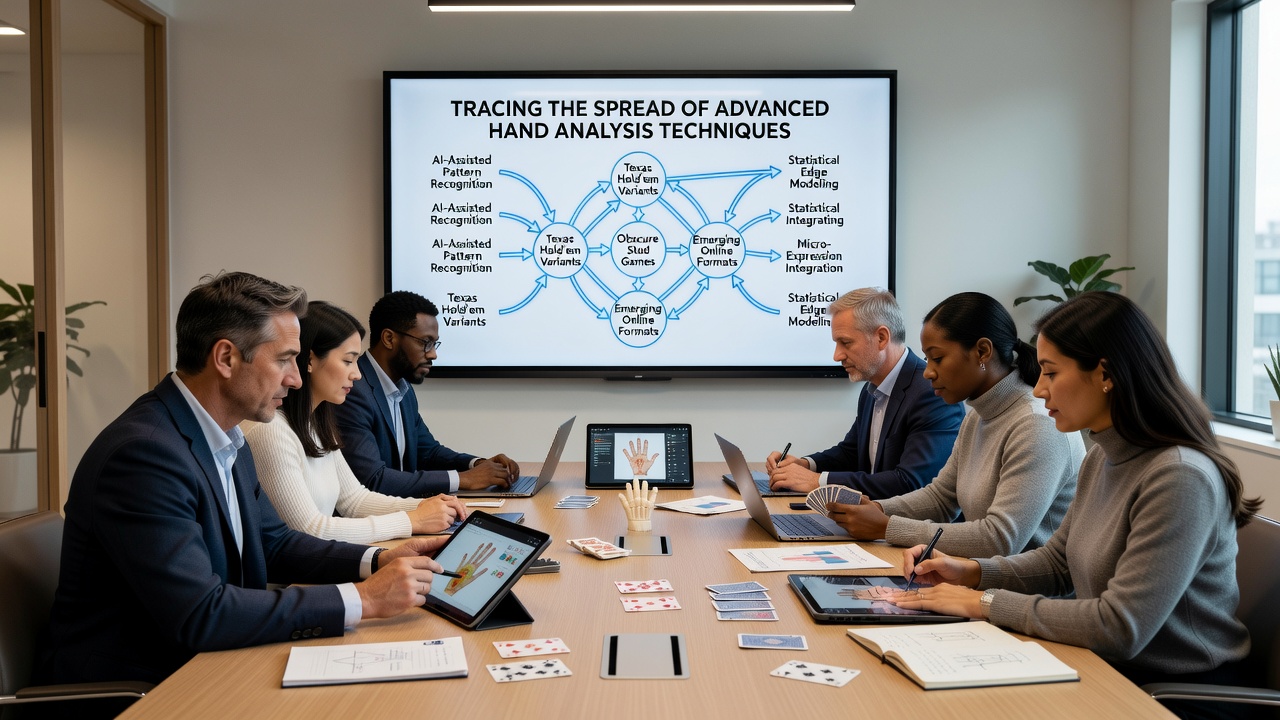
Community forums and private Discord servers serve as primary distribution channels, and analysts at European gaming research centers have mapped how video breakdowns of specific board textures spread from one circuit to another within weeks. One documented case involved a group in the Pacific Northwest adapting a solver output originally shared in a Canadian league, which altered river betting frequencies across multiple venues during the same season.
Equipment and Accessibility Factors
Portable devices now allow real-time equity lookups between rounds, and surveys from gaming trade organizations in Australia reveal that tablet usage during breaks correlates with higher adoption of multi-street analysis methods in subsequent play. These tools require less computational power than earlier versions, which lowers barriers for participants who travel to events without dedicated study time at home.
Training modules designed for major platforms appear in abbreviated form on mobile apps, and data from university-affiliated research groups shows that players in lesser-publicized events adapt these modules to shorter stack scenarios common in regional formats. The result is a faster feedback loop where hand histories from one weekend event inform decisions at another event held hundreds of miles away the following week.
Cross-Regional Comparisons
European circuits display similar diffusion patterns, though regulatory environments shape the visibility of software use. Reports from the Malta Gaming Authority track how players in smaller live events incorporate GTO-derived frequencies into live play without explicit discussion during tournaments. Australian state gaming commissions have noted parallel increases in post-event review sessions among participants who compete in suburban club tournaments.
Observers note that language barriers and time-zone differences slow some exchanges, yet shared file formats allow solver outputs to transfer across borders with minimal adaptation. Research papers published by independent gaming institutes highlight that these transfers occur most often after major holiday periods when travel between regions peaks.
Conclusion
Advanced hand analysis techniques continue to move through lesser-publicized card events via informal networks, portable devices, and shared data repositories, and statistics compiled through 2026 demonstrate steady growth in their application across multiple regions. The same mechanisms that spread these methods also create opportunities for further study by regulatory bodies and academic researchers interested in player behavior outside major platforms.